
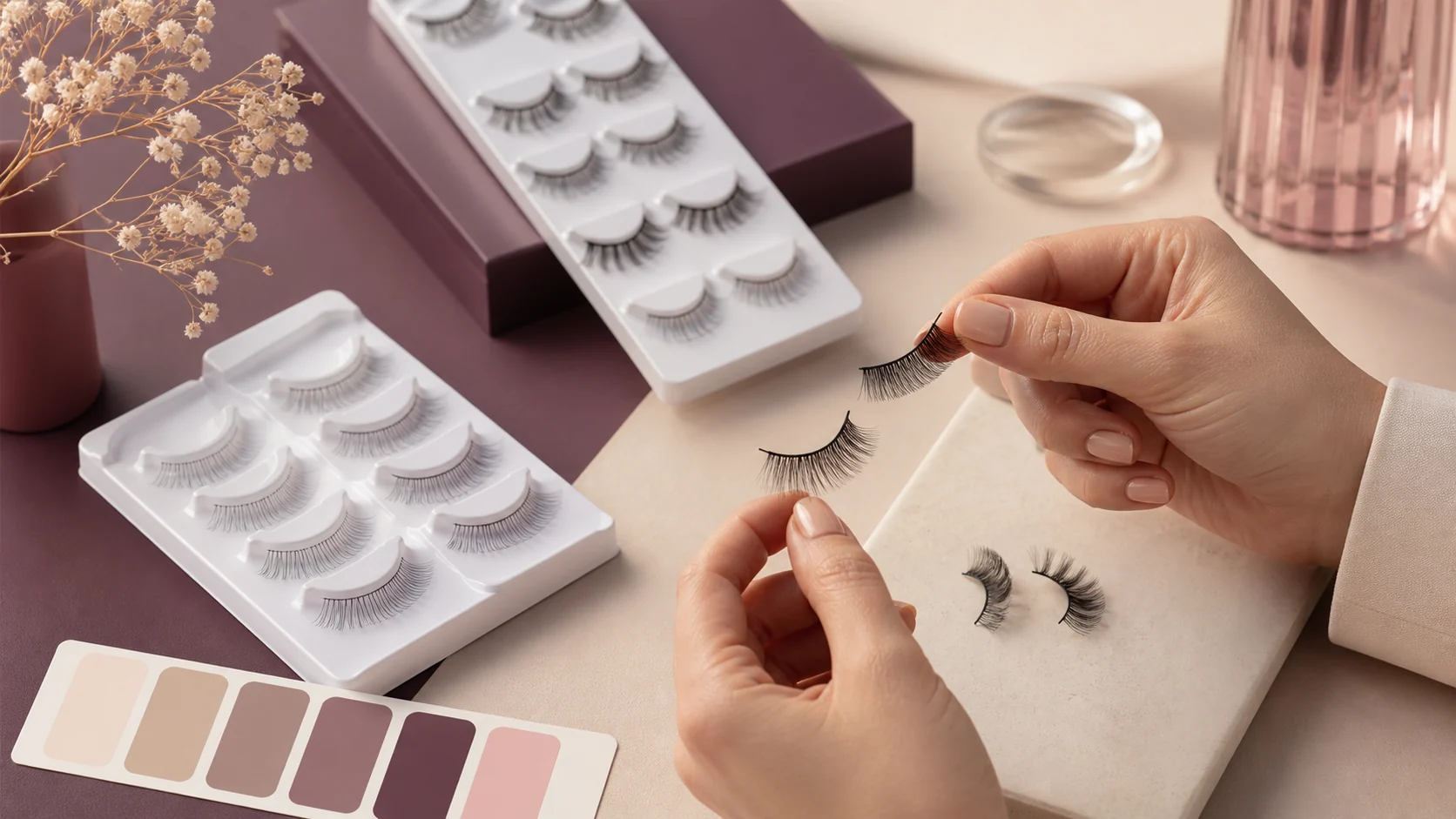
For a private-label lash range, start with the application routine you want customers to follow. Consider conventional strip lashes for a complete lash silhouette, self-adhesive formats for a pre-applied adhesive direction, non-pre-glued clusters for a buildable lash map, and magnetic formats for a system-specific lash and accessory concept. Then compare the exact SKU, included components and packaging.
These categories overlap. “Strip” and “cluster” describe lash construction; “self-adhesive” and “magnetic” describe attachment approaches. A cluster can be self-adhesive or non-pre-glued. Your sourcing brief should name both the construction and attachment method so that sample and quotation requests are comparable.
Compare four lash sourcing directions
| Direction | A useful starting point when… | Decisions to resolve before sampling |
|---|---|---|
| Conventional strip lashes | Your range is organized around complete looks, such as natural, wispy or fuller-volume styles. | Band and lash dimensions, single- or multipair pack, intended adhesive, and whether adhesive is included. |
| Self-adhesive lashes | Your concept centers on a ready-to-apply strip or cluster format. | Exact construction, adhesive specification, tray protection, applicator needs and product-specific instructions. |
| Non-pre-glued lash clusters | Your concept lets customers combine short lash sections into different maps. | Length mix, curl, cluster count, lash-only refill versus kit, and compatible application and removal components. |
| Magnetic lash systems | Your concept centers on a coordinated lash, application and storage system. | Exact magnetic structure, assembled-pair count, matching tools or liner where applicable, and case configuration. |
Treat these as shortlisting directions rather than guarantees of ease, wear time or performance. Compare samples before choosing the format for your audience.
1. Strip lashes: define the complete look and pack size
A strip-lash assortment can be organized by silhouette, band appearance and pack quantity. Review those choices together: a single-look launch and a multipair assortment create different packaging and stock-planning requirements.
Review the strip-lash collection and check the selected reference rather than transferring a feature from one product to another.
Ask:
- What are the band length, lash lengths and exact style code?
- Is the unit quoted one pair, one tray or a complete retail pack?
- Does the selected pack include adhesive, or is it a separate item?
- Which adhesive and application instructions are intended for this lash?
- Can the final tray hold the selected lashes without changing their presentation?
When comparing samples, use photographs taken in the same lighting and position. Record the style code beside each image so that similar-looking options remain traceable.
2. Self-adhesive lashes: specify the construction and instructions
Self-adhesive sourcing requires more detail than the label “glue-free.” Confirm whether the product is a full strip or a set of clusters and exactly how the selected version is intended to be applied, stored and removed.
Start with the self-adhesive lash collection. Include the selected variant and reference image in your request. Confirm style, length mix, tray quantity and tool configuration for that reference.
Before approving packaging, ask for the adhesive specification, protective presentation, storage guidance and instructions for the exact SKU. Clarify which claims, if any, have supporting evidence. The category name alone does not establish wear duration, reuse count, suitability for sensitive eyes or a particular safety claim.
For a convenience-led launch, assess whether a first-time customer can understand the provided instructions and identify the correct tool and lash orientation. Keep that usability review separate from any performance claim you plan to print.
3. Non-pre-glued clusters: decide between a refill and a complete kit
Non-pre-glued clusters are short lash sections selected and arranged into a lash map. A useful buying brief specifies the length mix, curl, base construction and number of clusters, together with the intended application system.
Review the non-pre-glued lash-cluster collection and compare contents explicitly for each selected reference. A tray and a complete application kit are different sourcing configurations.
For a refill, identify the system it is intended to work with. For a starter kit, request a component list covering the lashes, bond, seal, remover and applicator as applicable, with each item marked included, optional or excluded. Do not assume that a photographed tube establishes its formula, quantity or compatibility.
Also define the lash map you plan to teach. Ask whether the tray has enough of each length for that map, and make the counting unit explicit. A cluster count is not a finished-pair count.
4. Magnetic lashes: evaluate the whole system
Start with the exact attachment mechanism, then select the look. Review the magnetic lash category; “magnetic” alone is not a complete product specification.
Ask whether the selected reference uses matching upper and lower magnetic sections, a liner-compatible structure or another specified construction. Establish the required components and instructions for that particular system. Do not assume that a liner, applicator or case from a different SKU will be compatible.
Confirm:
- Which pieces form one complete lash, and how many assembled pairs are supplied?
- Which tool or liner, if any, is required and included?
- How are components identified and positioned in the case?
- What application, removal, cleaning and storage instructions accompany the selected system?
- What evidence supports any proposed reuse or performance statement?
Review the complete sample configuration before approving kit artwork or demonstrating the application method.
Match the format to your sales channel
Use the channel to set evaluation priorities rather than choosing a format from the channel alone.
- Online retail: Can product images show every included component? Can a customer distinguish a refill from a starter kit before purchase?
- In-store retail: Is the style, pack count and attachment method clear on the front and back of the pack? Are separately required items identified?
- Salon retail: Do the instructions clearly describe the intended customer-use system and its application method?
- Gift or demonstration sets: Does the pack include everything required for the demonstrated routine, or state what must be obtained separately?
If you are comparing two formats, select a similar visual style in each. This helps you evaluate the application and packaging differences without confusing them with a change in lash design.
Packaging and compatibility questions to settle early
A logo-ready pack still needs a complete product specification. Before requesting final artwork, resolve:
- Selling unit: State pairs or clusters per tray, trays per pack and all accessories included.
- Product fit: Confirm the dimensions and arrangement of lashes, tools and any liquid components against the actual tray or case.
- Component compatibility: Identify the exact adhesive, bond, seal, remover, liner or tool where the selected system requires one. Ask for confirmation of the proposed combination.
- Instructions and claims: Prepare application, removal and storage information for the selected product. Keep unsupported wear, reuse and safety claims out of the artwork.
- Market and channel information: Identify the destination country, label language, barcode needs and requested product documentation for review.
- Replacement items: If refills or replacement accessories are part of your plan, specify which starter kit they must match and ask whether they can be supplied separately.
Use the OEM/ODM and customization overview to organize the product, logo, packaging and sample-development discussion. The scope for a particular product remains subject to project confirmation.
A practical sample-review checklist
Use one checklist for every shortlisted reference and record the result rather than relying on memory.
- Identity: Collection, original SKU code, variant, reference image and sample date.
- Specification: Lash and band dimensions, curl, color, length mix and counting unit, as applicable.
- Contents: Actual quantities and components compared with the requested configuration.
- Presentation: Lash arrangement, symmetry, visible workmanship and condition after unpacking.
- Usability: Whether the supplied instructions, component labels and tool orientation are understandable for the intended customer.
- Compatibility: Written confirmation of the components evaluated together; list any proposed substitutions separately.
- Packaging: Tray fit, case closure, accessory placement, label readability and artwork position.
- Evidence: Product-specific documents and support for each proposed on-pack claim.
- Approval record: Accepted details, open questions and changes required before the next sample or production review.
Ask for separate confirmation of MOQ, sample charges, sample scope, production pricing and timing. Compare quotations only after aligning the product, accessories, branding and packaging included. Use the private-label lash kits, samples and MOQ quotation checklist for the commercial brief.
Frequently asked buyer questions
Are self-adhesive lashes and lash clusters the same thing?
They describe different aspects of a product. A cluster is a short lash section; self-adhesive describes an attachment approach. Specify “self-adhesive clusters” or “non-pre-glued clusters” in your request to avoid receiving the wrong format.
Does every lash kit include adhesive and an applicator?
Contents vary by SKU and configuration. Request an itemized list and confirm it against the sample. A lash tray, refill and starter kit should each state what is included and what the customer needs separately.
Which lash format is best for a new private-label brand?
Shortlist around your customer’s application routine, the look you want to sell and the instructions your channel can support. Compare complete samples, then choose using product fit, kit contents, packaging and confirmed commercial terms.
Can one quotation cover several formats?
List each selected reference as a separate line with its variant, quantity, accessories and packaging requirements. Ask for any shared branding or packaging costs to be identified separately so you can compare the options clearly.
Ready to shortlist your lash range?
Send the product links and original SKU codes you want to compare, your target country and sales channel, estimated quantity, refill or kit preference, packaging direction and target launch date.
Request lash samples for a product review, or request a quotation with your selected configurations. If you are still defining the project, use the OEM brief guide to organize the information.
This guide provides general sourcing information. Confirm the selected product, commercial terms and destination-market requirements during your project review.